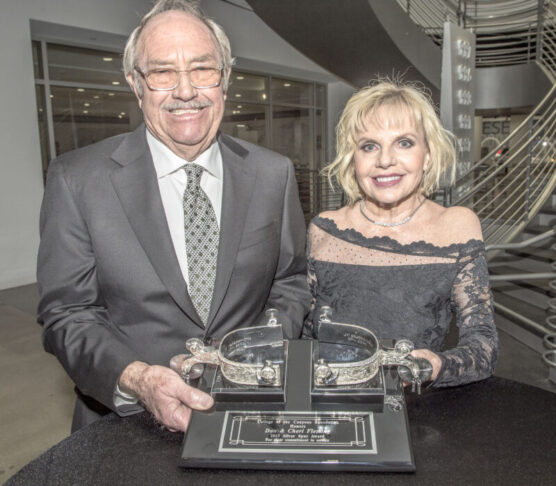

Don Fleming, owner of Valencia Acura and president of the Santa Clarita Auto Dealers Association, died on Sept. 8 at age 84. Fleming, the 2004 Santa Clarita Valley Man of the Year and well known in the SCV for his philanthropy, will be honored with a Celebration of Life on Monday, Nov. 9, at 1 p.m.
The service, honoring Fleming’s life, community leadership and lasting contributions to the Santa Clarita Valley, will be held at the Crossroads Community Church, 25300 Rye Canyon Road, Valencia, CA 91355.
Fleming, a U.S. Marine Corps veteran, business leader and dedicated community advocate, spent nearly three decades bringing people together to strengthen local businesses, support nonprofits and advance community causes. The celebration will honor the generosity, determination and friendship that defined his life and the legacy he leaves throughout the Santa Clarita Valley.
Among his many honors Fleming, with wife Cheri, was named the 2019 honoree of the College of the Canyons Foundation Silver Spur Award for Community Service.
In lieu of flowers, the Fleming family invites friends to consider a memorial gift to the Santa Clarita Valley Boys & Girls Club at scvbgc.org.
The Boys & Girls Club of Santa Clarita Valley posted the following message on social media:
“As we continue to remember and honor the life of Don Fleming, we are reflecting on the incredible legacy he leaves throughout the Santa Clarita Valley.
Don and his late wife, Cheri, shared a long and meaningful history with Boys & Girls Club of Santa Clarita Valley. Their generosity, leadership, and belief in giving back helped strengthen our Club and expand opportunities for local youth.
Together, Don and Cheri co-chaired our annual auction for three consecutive years during the 2000s, helping make it one of the most successful fundraising efforts in our history. Just as importantly, they opened their home, invited friends and business leaders into the Club’s circle, and used their influence throughout Santa Clarita to advocate for kids and families.
Don believed that when you make your living in a community, you have a responsibility to give something back to it. He lived that belief fully.
We are especially honored that Don’s family chose to recognize the Boys & Girls Club of Santa Clarita Valley as part of the way his legacy is remembered. It is a meaningful tribute to a life defined by generosity, service, and love for this community.
We remain grateful for Don’s friendship, his leadership, and the lasting difference he made for generations of young people.”
“My dad believed friendship was something you lived every day. You could see it in the way he cared for our team, welcomed customers and made time for people throughout Santa Clarita,” said Fleming’s son, Brian Fleming. “That same spirit guided his community service. He gave his time and energy because he cared about our community and wanted to make a difference. I learned so much from watching him, and carrying that spirit forward is one of the most meaningful ways we can honor him.”